Most people born and raised in Canada would claim the toque, maple syrup and of course ice hockey to be ‘truly Canadian’. In light of the recent tragedy in Humboldt at least one of these things united our country and validated it’s own importance to Canada.
Ice hockey has been played in community rinks across this country since 1875 and many Canadians place an almost religious value on the game. My name is Rob Martin and I have the unique opportunity as a YREACH Immigrant Settlement Worker to welcome and assist newcomer families who choose Cape Breton and Canada as their new home. Part of my role is to teach people about Canadian culture and to support their journey toward official Canadian status. I certainly can’t promote our culture without referencing our beloved game. Over the years I’ve watched people from 32 different countries embrace ice hockey in some way, shape or form.
On April 6, 2018, tragedy struck in Saskatchewan, when a catastrophic bus accident claimed the lives of 16 people and injured another 13. The bus was carrying members of the Humboldt Broncos ice hockey team as well as coaches and others associated with the team. Our nation immediately banded together and supported one another to grieve this horrific loss. Hockey communities in particular stepped up and initiated ‘Jersey Day’ for Humboldt across Canada on April 12.
It was a wonderful display of unity and a great teaching/learning opportunity within our YREACH program. Our EAL Teacher (Susan Burchell) used her April 12 language class to openly discuss the significance of ice hockey and Jersey Day with some of our immigrant adult language students. I brought multiple hockey jerseys to work and offered them to our friends who hail from Syria and Algeria. The gentlemen were elated to pull on the sweaters and they walked proudly throughout the hallways of our building…one carrying a hockey stick that I freshly taped green that morning for Humboldt. These newcomers like so many others, love Cape Breton, Nova Scotia & Canada. Dawning these jerseys helped them feel connected to our country and the pure, innocent smiles that they displayed reflected this.
CBC TV caught wind of our little Jersey Day celebration and offered to feature the gents on the news! The reporter asked Ahmad Hammadi, “How do you feel about the tragedy in Humboldt and what does Jersey Day mean to you?” Ahmad responded, “It is a terrible tragedy and we are very sad because those people are our family”. Ahmad is just learning the English language and his response was not planned or rehearsed. It was spoken from the heart. Canada’s foundation is built on heart so Ahmad, his friends, family and many other newcomers are already innately Canadian.
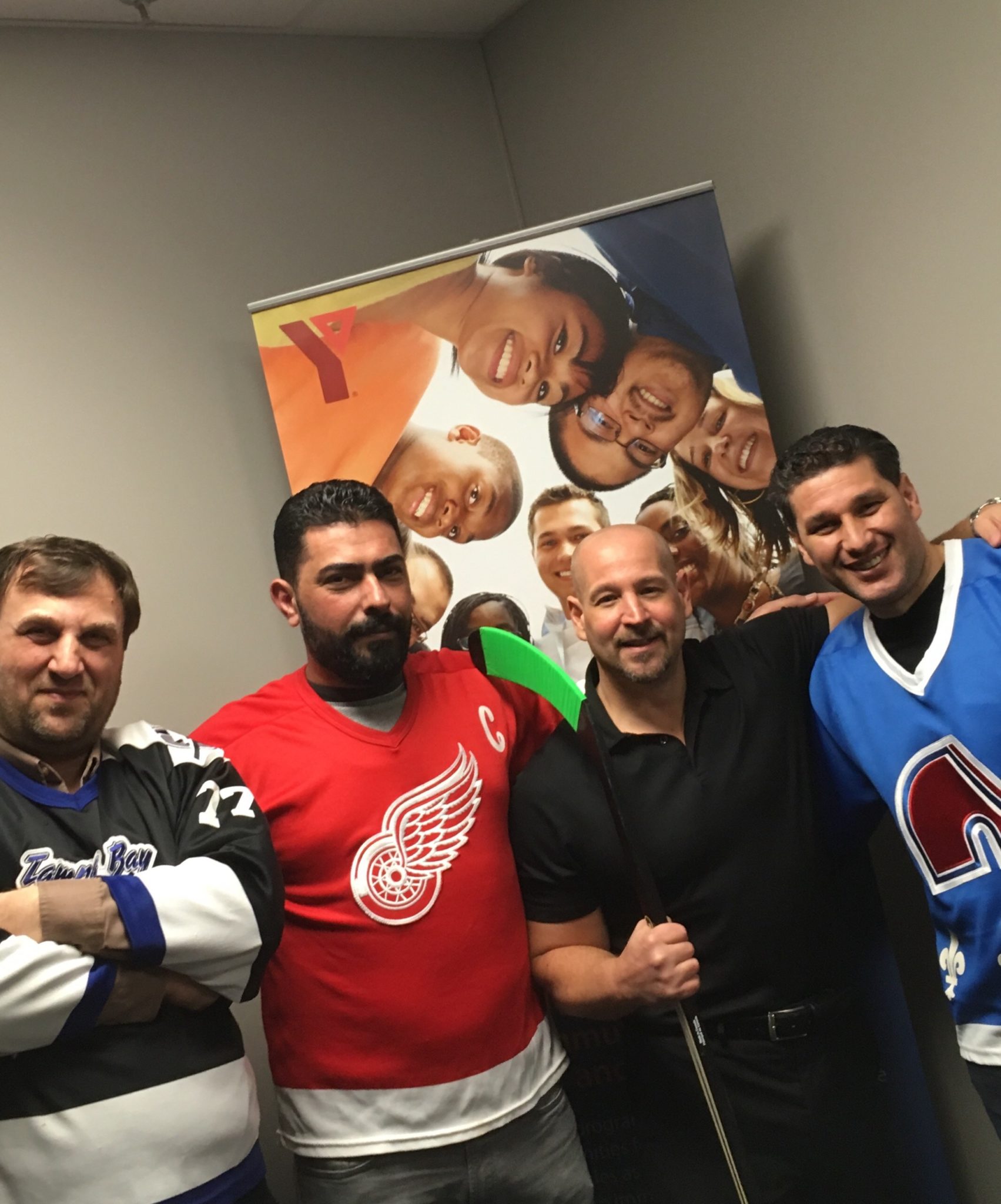
(Picture L-R: Fadi Hanna-Syria, Ahmad Hammadi-Syria, Rob Martin & Ammar Khettou-Algeria)
Rob Martin
902-217-0565
Originally posted by Chris Shannon of the Cape Breton Post.
SYDNEY — The Cape Breton Local Immigration Partnership is launching a series of 13 meetings across the island to get a better understanding of what makes a “welcoming and inclusive” community.
The sessions begin on Saturday in North Sydney and Sydney Mines, and will continue over the next two months.
The local immigration partnership is nearly one year into its mandate — a federal initiative funded through Immigration, Refugees, and Citizenship Canada to address the growing need for community planning in the areas of immigrant attraction and retention.
Click here to read the original post.
(SYDNEY, NS) – The Cape Breton Partnership announced today that Carla Arsenault is the successful candidate in a recent competition to fill the organization’s role of President & Chief Executive Officer (CEO). Carla begins her new role as President & CEO immediately and will be responsible for implementing the organization’s strategic action plan to ensure efficient, accurate, and transparent financial and operational management.
“The Board is pleased to welcome Carla Arsenault to the position of President & CEO. Her experience working with the organization as the Chief Operating Officer will play a key role as the organization transitions to new leadership. The President & CEO is a pivotal position in a multifaceted organization that works to with private sector to identify and create new opportunities in Cape Breton,” said Alex Paul, Chair of the Cape Breton Partnership Board of Directors. “Carla is a demonstratively talented and capable professional with valuable experience gained in the public and private sector. She has a strong background in management and operations that will contribute noticeably to on-going and new efforts being put forward by the Partnership to shape a more vibrant and enterprising economic climate for Cape Breton. Carla will enhance the work of the Partnership team and support our Investors by strengthening the region’s capacity for growth.”
Carla has earned a Bachelor of Public Relations with a Certificate in Marketing, as well as a Master’s in Business Administration (MBA), specializing in Management Consulting. She has spent the 15 years in the global corporate sector with Hewlett Packard developing solutions to operational barriers and challenges. Over the past year Carla has worked as the Partnership’s Chief Operating Officer ensuring the organization’s objectives aligned with the strategic vision set forward by the Board of Directors. Carla has also lead the implementation of several key projects and managed the core activities for the Cape Breton Partnership and Cape Breton Regional Enterprise Network.
“Growing up in Richmond County, and spending my professional career in the CBRM provides me with an island-wide perspective that will represent the Partnership’s mandate well. I am pleased to continue to work alongside our dynamic team of colleagues, the Board of Directors, and Investors to advance our region’s economic prosperity and build our collaborative and progressive network of leaders, entrepreneurs, and private sector business owners,” said Carla Arsenault, President & CEO of the Cape Breton Partnership. “Priority projects for the Partnership include the delivery of the Cape Breton Regional Enterprise Network activities, and management of the Prosperity Framework, Immigration Projects, Elevate magazine, Innovation initiatives, the Safety First in Cape Breton Network, and NextGen Cape Breton. I look forward to doing my part in leading this organization to make Cape Breton a stronger and more efficient place to do business.”
The Cape Breton Partnership is dedicated to developing a united approach to addressing economic issues and growth opportunities within the region, while also encouraging the retention and expansion of existing companies by identifying barriers and ways to remove them.
Media Contact:
Carla Arsenault
President & CEO, Cape Breton Partnership
902-562-0122 (w) 902-577-2455 (c)
carla@capebretonpartnership.com
 When is a newcomer no longer new? Is there a time limit? Maybe there’s a milestone they reach? And what does a newcomer become when this happens? Omar Tag El-Din did not have the answers to these questions in 2012.
Omar landed in Montreal as an immigrant from Egypt with his dog, Gonzales, in June of 2012. When Omar arrived he had the ultimate goal of finishing his BBA at Cape Breton University where he completed his studies two years later. He wanted to make his Human Resources experience from Egypt more relevant in Canada, so he pursued an Advanced Diploma in HR Management from NSCC Marconi Campus and knocked it out of the park with Honours in 2015.
Although Omar initially intended to leave after receiving his education and pursue a career in a larger city, something happened to change that course. After years living in Cape Breton, he had adjusted to the lifestyle in his new home and realized nowhere else felt right.
Imagine moving from the immensely populated city of Cairo with a population of approximately 30 to 40 million residents, to the Sydney community of 30 thousand people, where you rarely get into a traffic jam. This is quite a transition if you have ever been on a road in a Middle Eastern country.
Soon after completing his Advanced Diploma, an HR opportunity in Halifax presented itself. Omar took that leap, and in the same year attained Canadian Citizenship. But he always wondered, at this time in his life, if he’d finally reached something more than “newcomer” status, or if this was just the real beginning to it. He still had no answer to those questions. After successfully completing his contract in 2016 and getting promoted to a Special Projects Coordinator position, Omar found himself with a new employer.
The following year was another defining moment, when Omar became the successful candidate for the Cape Breton Partnership to lead the Atlantic Immigration Pilot (AIP) Program in Cape Breton. His background in recruitment, development, and projects management in addition to being an immigrant himself are considered to be tools that would allow him to be an ideal recruit for his role at the Partnership.
Ironically, or maybe due to accidental kismet, Omar celebrated one year since attaining his citizenship while he was overseeing a presentation on the AIP’s international graduate stream to Cape Breton University’s international students centre. Omar now champions immigration, diversity, and inclusion while supporting employers facing labour shortages through the AIP and promoting the economical benefits of Immigration. Both he and Gonzales await a deeply missed Cape Breton summer, something they are looking forward to since they came back.
From an Immigrant, to a Canadian, to an Immigration Champion right here in Cape Breton. It’s not clear when exactly it happened, maybe slowly over time or maybe at a specific moment, but at some point during his journey to this moment Omar has done it: He’s gone from “newcomer” to “seasoned Cape Bretoner”.
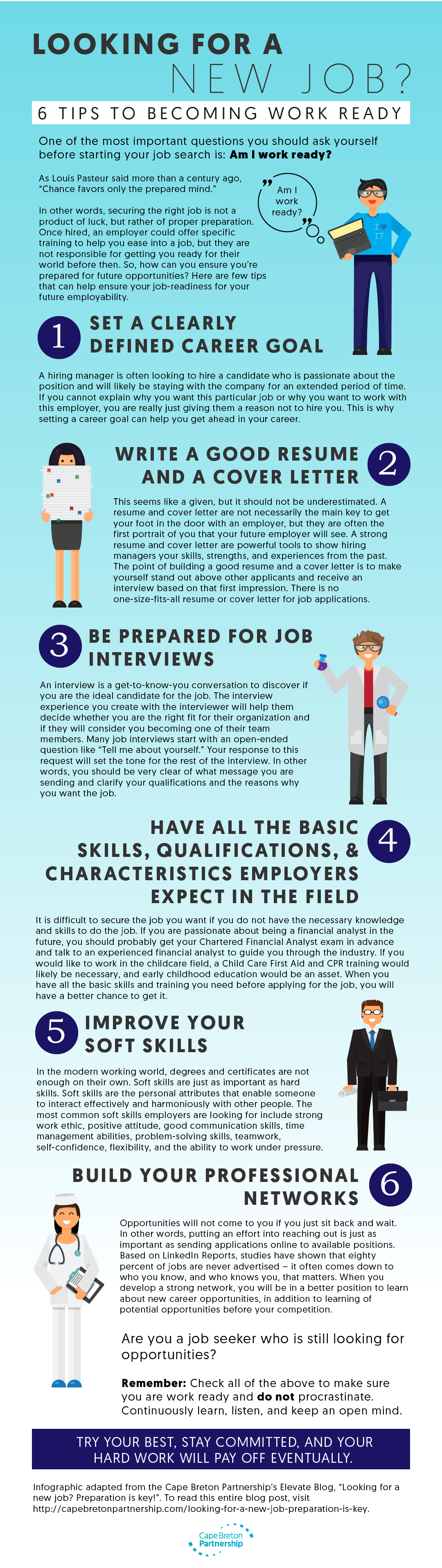
6 TIPS TO BECOMING WORK READY
Finding employment can be a real challenge. Job seekers are trying everything they can think of to get a job, but they don’t always hear back from the employers they are submitting applications to. Some applicants may even consider undervaluing themselves to improve their odds of being picked up by an employer, even when these positions/workplaces are not aligned with their education, qualifications or interests. Some new graduates also face challenges for not having enough experience or professional connections in their fields, which can put an early stop to their prospective career-path. These barriers may all exist, but they should not be seen as reasons to stop you from moving forward.
One of the most important questions you should ask yourself before starting your job search is: Am I work ready? As Louis Pasteur said more than a century ago, “Chance favors only the prepared mind.” In other words, securing the right job is not a product of luck, but rather of proper preparation. Once hired, an employer could offer specific training to help you ease into a job, but they are not responsible for getting you ready for their world before then. So, how can you ensure you’re prepared for future opportunities? Here are few tips that can help ensure your job-readiness for your future employability:
1. Set a clearly defined career goal
A hiring manager is often looking to hire a candidate who is passionate about the position and will likely be staying with the company for an extended period of time. If you cannot explain why you want this particular job or why you want to work with this employer, you are really just giving them a reason not to hire you. This is why setting a career goal can help you get ahead in your career. A career goal is a specific statement that explains what you want to achieve throughout your career. Setting a career goal is about finding your passion and figuring out steps to reach that point. It is a great way to get to know yourself better and build a plan for your future. The criteria for developing career goals should be SMART – Specific, Measurable, Attainable, Relevant, and Timely. When you are confident and clear about what you would like to accomplish and why, you are saving time and energy for the real work. Set aside some time to define your goal and you will benefit from a clear mind guiding your job seeking actions.
2. Write a good resume and a cover letter
This seems like a given, but it should not be underestimated. A resume and cover letter are not necessarily the main key to get your foot in the door with an employer, but they are often the first portrait of you that your future employer will see. A strong resume and cover letter are powerful tools to show hiring managers your skills, strengths, and experiences from the past. The point of building a good resume and a cover letter is to make yourself stand out above other applicants and receive an interview based on that first impression. There is no one-size-fits-all resume or cover letter for job applications. You should customize your resume, tailoring it to different types of jobs and employers depending on your chosen field, and you should always write your cover letter to the specific job/employer it is directed to.
3. Be prepared for job interviews
An interview is a get-to-know-you conversation to discover if you are the ideal candidate for the job. The interview experience you create with the interviewer will help them decide whether you are the right fit for their organization and if they will consider you becoming one of their team members. Many job interviews start with an open-ended question like “Tell me about yourself.” Your response to this request will set the tone for the rest of the interview. In other words, you should be very clear of what message you are sending and clarify your qualifications and the reasons why you want the job. Besides preparing a good introduction, you should do some research about the company and the industry. Research will ensure you have a clear idea of who you are talking to and what kind of questions they may have. Do not forget to practise your interview skills before you go into a real one.
4. Have all the basic skills, qualifications, and characteristics employers expect in the field
It is difficult to secure the job you want if you do not have the necessary knowledge and skills to do the job. If you are passionate about being a financial analyst in the future, you should probably get your Chartered Financial Analyst exam in advance and talk to an experienced financial analyst to guide you through the industry. If you would like to work in the childcare field, a Child Care First Aid and CPR training would likely be necessary, and early childhood education would be an asset. When you have all the basic skills and training you need before applying for the job, you will have a better chance to get it. Try to apply for some jobs in your field to see about their job requirements. The more you know, the better prepared you are for your dream job.
5. Improve your soft skills
In the modern working world, degrees and certificates are not enough on their own. Soft skills are just as important as hard skills. Soft skills are the personal attributes that enable someone to interact effectively and harmoniously with other people. The most common soft skills employers are looking for include strong work ethic, positive attitude, good communication skills, time management abilities, problem-solving skills, teamwork, self-confidence, flexibility, and the ability to work under pressure. You cannot learn soft skills in a day. You need to practise often to develop them. Find the soft skills you would like to improve on and then make a plan to learn and practise them. Remember that practice makes perfect.
6. Build your professional networks
Opportunities will not come to you if you just sit back and wait. In other words, putting an effort into reaching out is just as important as sending applications online to available positions. Based on LinkedIn Reports, studies have shown that eighty percent of jobs are never advertised – it often comes down to who you know, and who knows you, that matters. When you develop a strong network, you will be in a better position to learn about new career opportunities, in addition to learning of potential opportunities before your competition. Attending some networking events and having conversation with professionals in your field will definitely be a big help for your career planning and job hunting.
Are you a job seeker who is still looking for opportunities? Remember: Check all of the above to make sure you are work ready and do not procrastinate. Continuously learn, listen, and keep an open mind. Try your best, stay committed, and your hard work will pay off eventually.